
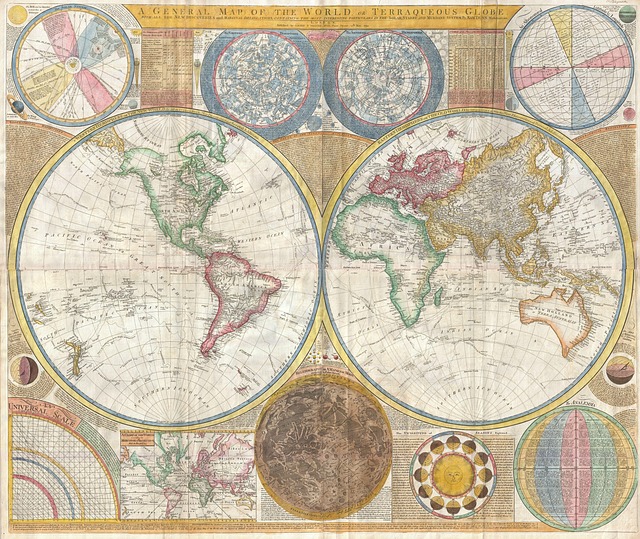
Overview of the Chapter: The Globe and Maps
This chapter introduces students to the concepts of globes and maps, their importance, and how they help us understand the Earth's geography. It covers the basic differences between a globe and a map, types of maps, and their uses in daily life.
Globe: A globe is a small spherical model of the Earth that shows its continents, oceans, and countries in their actual shapes and relative sizes.
Map: A map is a flat representation of the Earth's surface or a part of it, showing physical and political features.
Key Topics Covered
- Understanding the Globe
- Types of Maps
- Components of a Map
- Uses of Maps and Globes
Understanding the Globe
A globe is an accurate representation of the Earth as it shows the correct shapes, sizes, and locations of landmasses and water bodies. It helps in understanding the Earth's rotation, day and night cycles, and time zones.
Types of Maps
Maps can be classified into different types based on their purpose:
- Physical Maps: Show natural features like mountains, rivers, and plains.
- Political Maps: Display boundaries of countries, states, and cities.
- Thematic Maps: Focus on specific themes like rainfall, population, or transportation.
Components of a Map
Every map has essential components that help in reading and interpreting it correctly:
- Title: Indicates the subject of the map.
- Scale: Shows the ratio between distances on the map and actual distances on the ground.
- Legend/Key: Explains symbols and colors used on the map.
- Directions: Usually marked with a compass rose to show north, south, east, and west.
Uses of Maps and Globes
Maps and globes are useful in various ways:
- Helps in navigation and locating places.
- Used in planning travel routes and understanding geographical features.
- Important for education, research, and government planning.